Brainfood Cloud Team – Editorial Briefing
If your creation, distribution, and monetisation still live in separate systems, the loop you need is being held back by the stack you have. Explore how Brainfood Cloud connects the full publishing lifecycle into one intelligent operating layer and turns performance into your next advantage.
The production line is breaking.
For most of the digital era, the publishing business ran like a factory. Content was created at one end, pushed out through distribution, monetised by a commercial team, and measured by analysts who reported back, eventually, on what happened. Each stage was a department, each department had its own tools, and the work moved in one direction. It was orderly, and for a long time it worked.
It worked because the model rested on an assumption that no longer holds: that audiences would keep arriving through predictable channels, primarily search. That assumption is now visibly failing. Chartbeat data published in early 2026 found that small publishers had lost roughly 60% of their search referral traffic over two years, with medium publishers down around 47% and even large publishers down more than a fifth. The Reuters Institute’s 2026 survey of 280 executives across 51 countries found that publishers expect search referrals to fall a further 43% over the next three years, as AI answer engines increasingly satisfy queries before a reader ever reaches a site.
When the top of the funnel erodes this fast, a linear production line has no way to respond. By the time the analytics report lands, the audience behaviour it describes has already moved on. The model is too slow because it is built the wrong shape.
The loop replaces the line.
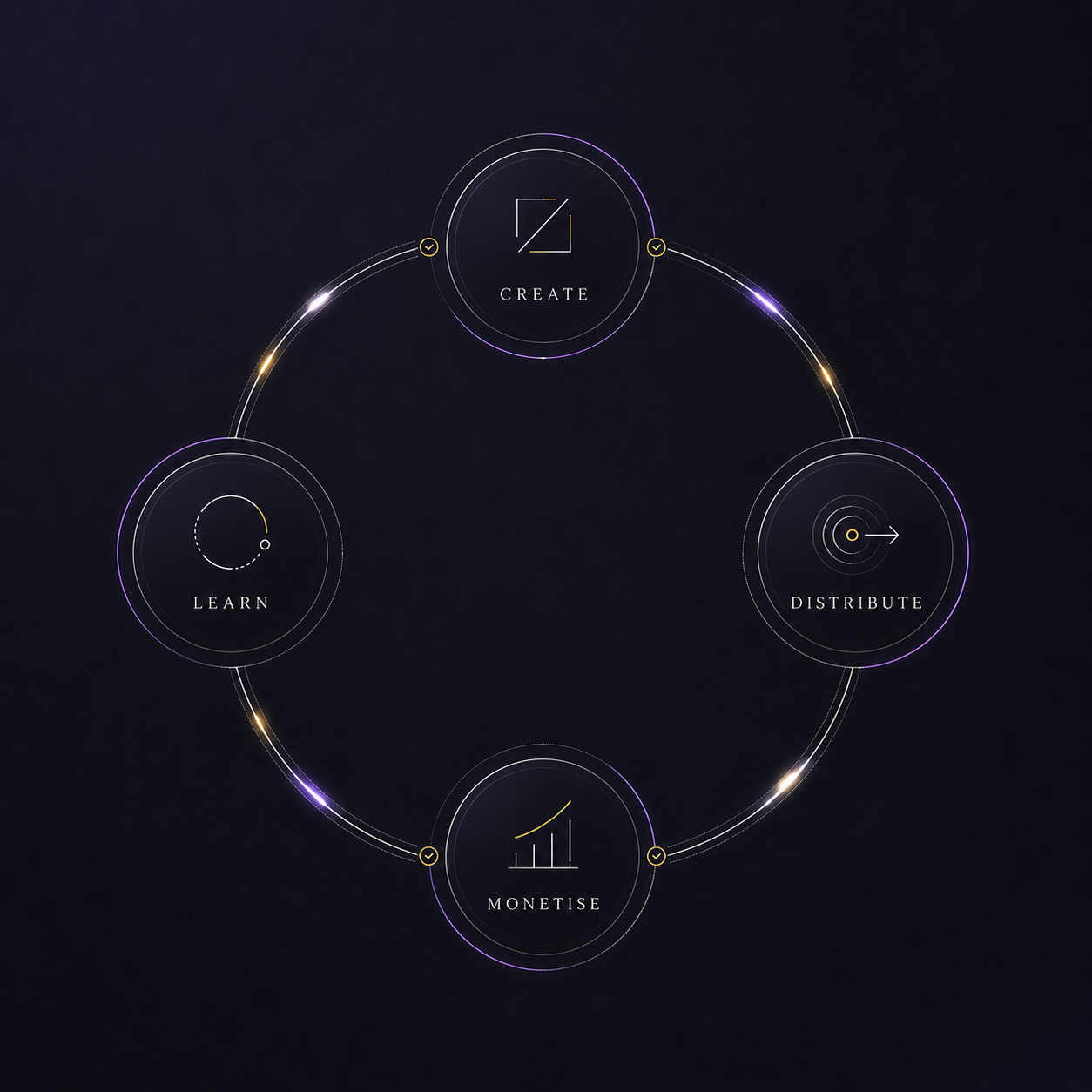
The publishers adapting best are not simply making more content or buying more tools. They are changing the shape of the operation from a line into a loop. Four stages, continuously connected:
Create. Turn information, sources, and editorial ideas into structured, publishable content efficiently, and at the volume modern audiences and formats demand, without surrendering editorial standards.
Distribute. Adapt every piece of content into the formats each platform and audience actually consumes, and push it where the audience is increasingly through owned channels and social, not just search.
Monetise. Connect that audience attention to revenue, particularly through video advertising, as a deliberate part of the workflow rather than a bolt-on managed in a separate system.
Learn. Feed performance signals from distribution and monetisation directly back into the next creative and commercial decision so the system gets smarter with each cycle instead of merely reporting on the last one.
The difference between a line and a loop is the fourth stage. In a production line, learning is a backward-looking report. In a loop, learning is the connective tissue that makes the other three stages adaptive. What performs, where it monetises, and which formats travel becomes an input to the next decision, not a post-mortem.
Why the loop is hard to run today.

If the loop is the obviously better model, why doesn’t everyone already run it? Because most publishers cannot, structurally.
The industry spent a decade buying best-of-breed point solutions and stitching them together: a CMS here, an AI writing tool there, a social scheduler, an analytics dashboard, an ad stack, a video player. Each was the right choice in isolation. Together they produced a fractured operation where the four stages live in separate systems that do not talk to each other. Creation data does not reach the commercial team. Monetisation signals never inform the editorial calendar. Performance learning sits in a dashboard nobody acts on quickly enough.
This is why 2026 is being described across the industry as the year of the “Great Consolidation” in publisher technology. After a decade of fragmentation, the bill has come due: redundant licensing, constant context-switching, and coordination delays between departments. There is also a sharper, AI-specific reason for the shift. As industry analysts have put it bluntly, an autonomous agent cannot navigate a disconnected tech stack — publishers hoping to capture the next wave of AI efficiency will struggle if their data foundation is fractured. The loop requires connection. Fragmentation prevents it.
In other words, the operating model the market now demands is precisely the one a fragmented stack cannot support.
The loop is an infrastructure decision, not a content decision
This is the strategic point most easily missed. Running publishing as a loop is not primarily about better content, better social, or better ad operations in isolation. Each of those can be optimised independently and still leave the business slow, because the value is in the connections between stages — and connections are an infrastructure question.
A publisher can have an excellent newsroom, a capable social team, and a competent commercial function, and still operate a broken loop if those three cannot share signals in something close to real time. Conversely, a more modest operation running a genuinely connected loop will out-adapt a larger one that is still passing work down a line. The competitive advantage is moving from the quality of any single stage to the intelligence of the connection between all four.
That reframes the buying decision for senior leaders. The question is no longer “which is the best AI writing tool” or “which is the best video monetisation vendor.” It is “what is the operating layer that lets creation, distribution, monetisation, and learning function as one system” — because that layer, not any individual tool, is what determines how fast the business can respond to a market that is now changing in months, not years.
Where Brainfood Cloud fits
This is the model Brainfood Cloud is built around. Rather than adding another point solution to the stack, it is designed as the intelligent operating layer that connects the four stages: MediaSync.ai supports structured, multilingual, SEO-ready content creation; Publio.ai transforms articles into platform-native social formats and supports distribution; and Cleon.tv supports video advertising and publisher-first monetisation. The connective ambition across them is the “Learn” stage — letting performance inform what happens next, so the loop tightens over time.
The goal is not to replace editorial, social, or commercial teams, and not to automate judgment out of the business. It is to give those teams a connected operating model where create, distribute, monetise, and learn finally work as one loop instead of four silos — which is the only structure fast enough for the conditions publishers now face.
The takeaway
The publishers who struggle over the next few years will not be the ones with the weakest content. They will be the ones still running a production line while the market rewards a loop. Audiences no longer arrive in an orderly queue, referral channels are contracting, and AI advantage flows to organisations whose data and workflow are connected. The strategic move is to stop optimising the stages in isolation and start building the loop that connects them. Create, distribute, monetise, learn — and then do it again, smarter each time.