Brainfood Cloud Team – Editorial Briefing
Translation is no longer the bottleneck.
For years, going multilingual meant a hard trade-off: pay for human translators and move slowly, or use machine translation and accept visibly worse quality. By 2026 that trade-off has largely dissolved for one category of content. Modern machine translation handles structured, informational text well — fast, cheap, and accurate enough that some enterprises now report a majority of AI-generated translations being approved for publication with little or no editing.
For a CDO or Head of International, that is genuinely good news, and it is also a trap. Because once raw translation stops being the constraint, leaders are tempted to treat multilingual expansion as a solved, mechanical problem: connect a translation engine, multiply the content, enter the market. That assumption is where multi-market strategies quietly go wrong.
The reason is simple. The same research that praises machine translation for structured content is equally clear about where it struggles: context, tone, cultural nuance, specialised terminology — and brand voice. In other words, machine translation is strong at exactly the part of publishing that doesn’t differentiate you, and weak at exactly the part that does.
The real problem is identity, not accuracy.
A publisher’s value is not that its sentences are grammatically correct in twelve languages. It is that a reader in any of those markets recognises a consistent editorial voice, a level of quality, and a point of view they trust. That is the asset multi-market expansion puts at risk.
The failure mode is rarely a mistranslated word. It is subtler and more corrosive: an English feature with a sharp, confident voice arriving in another market as flat, generic, technically-correct prose. Idioms flattened, cultural references stripped, the editorial personality sanded off. Multiply that across markets and formats and the brand becomes inconsistent — recognisable in its home market, anonymous everywhere else. Industry analysis of multi-market expansion names this directly: as brands scale across languages, the recurring damage is duplicated workflows, fragmented systems, and inconsistent brand voice.
Note that two of those three problems are operational, not linguistic. The voice doesn’t degrade because the translation is bad. It degrades because the operation around the translation is fragmented.
Voice is governed upstream, not fixed downstream.
The most important shift in how serious organisations approach this in 2026 is that they stop trying to protect voice at the moment of translation and start protecting it before translation happens.
The emerging best practice is to fix brand voice, terminology, and structure in advance, through centralised glossaries, protected terms that must never be altered, and style rules that guide tone and phrasing across every language. The translation engine then operates inside those guardrails rather than improvising past them. Industry commentators put the distinction sharply: the winners in 2026 are not the publishers simply using AI translation, but the ones running an AI translation system, routing content intelligently, measuring quality continuously, and governing the whole workflow.
This is why voice consistency is fundamentally a content-operations problem. If your source content is structured, tagged, and governed by a clear editorial standard, that standard can travel with the content into every market. If your source content is unstructured and your systems are fragmented, there is nothing for the standard to travel through, and voice is left to the mercy of whatever each disconnected tool does by default.
The practical implication for leaders: the lever for multilingual quality is not a better translation vendor. It is a more structured and connected content operation.
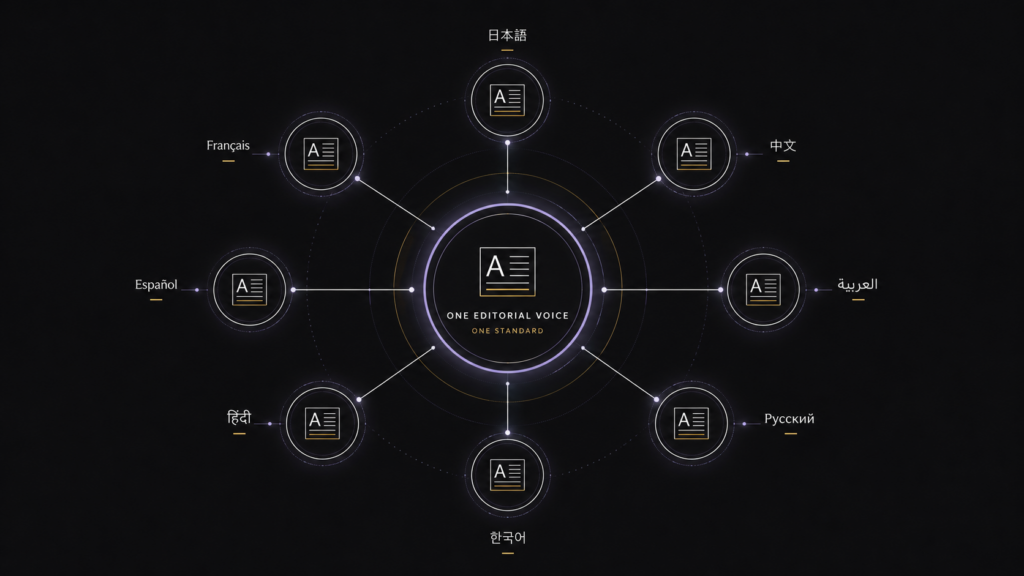
Distribution multiplies the challenge.
There is a second multiplier most expansion plans underestimate. Entering a market is not just translating articles, it is showing up natively on that market’s platforms. The same story may need to become a LinkedIn post, an Instagram carousel, a reel script, and a newsletter teaser, and the platform mix and conventions differ by market.
This is where the voice problem compounds. It is one thing to maintain editorial identity across twelve language versions of an article. It is another to maintain it across twelve languages multiplied by several platform-native formats each, produced under deadline by teams who may not all share the same editorial instincts. Done manually, this is where consistency collapses — not in the article, but in the dozens of downstream social assets that represent the brand to most of the audience.
The principle the whole industry now converges on is human-AI symbiosis: let automation provide the speed, scale, and consistency that global operations require, and reserve human expertise for the cultural and contextual judgment that machines cannot supply. That balance only works if the workflow is built to support it, if there is a connected path from a governed source story to its translated versions to its market-specific social formats, with human checkpoints where they matter.
Where Brainfood Cloud fits.
This is the operating model Brainfood Cloud is designed to support, across two of its pillars working together. MediaSync.ai is built to help editorial teams create structured, multilingual, SEO-ready content while keeping editors in control of tone and quality — which is precisely the upstream structure and governance that voice consistency depends on. Publio.ai then helps transform that content into platform-native social formats and supports distribution, extending the same editorial standard into the downstream formats where consistency is hardest to hold.
The connection between them is the point. Multilingual scale fails when creation and distribution live in separate, fragmented systems, because the editorial standard has no continuous path to travel. Within one connected layer, the same structure, terminology, and voice can be carried from the source story through its language versions and into each market’s social formats with human judgment kept in the loop rather than automated out of it. The goal is not to translate more cheaply. It is to expand into more markets without becoming anonymous in any of them.
The takeaway.
For content-heavy and multi-market publishers, the strategic question has moved. It is no longer “can we translate this well enough” — increasingly, the machines can. It is “can we expand our language coverage without diluting the voice and quality that made the brand worth reading in the first place.” That outcome is not bought from a translation engine. It is built into a structured, connected content operation where editorial standards govern the work upstream and travel with it all the way to the reader in every language, on every platform.